Slop vs Anti-slop
Whether you are slop or anti-slop probably says a lot about your politics in 2025.

We’re getting into one of my favourite times of the year. Yes, Christmas, but also the period when the different dictionary companies announce their words of the year. Dictionary.com went with “6’7”, which is fun as it’s not a word, and it’s also “impossible to define”. Collins went with “vibe coding”, which is also a fun choice (but also technically not a word?).
Slop has to be in with a shout as one of the breakout words of 2025. It moved from being twinned with “AI” (as in “AI slop”) to become a shorthand buzzphrase in its own right. It’s also reached the point where we’re creating slop portmanteaus. I recently explored the concept of “slopnomics”; Sean Monahan has been writing about “slopulism” (which is very good), and “workslop” has also gained momentum in recent months.
“Slop” is also worthy of its place in the pantheon, as it is a concept people love to hate. It has become a catch-all term for anything deemed to be of low value on the internet.
Given the feeling that slop represents everything terrible about the internet (and the world to a certain extent), it’s unsurprising that Zohran Mamdani received praise in the aftermath of his mayoral victory for being “The Opposite of Slop Politics”. Charlie Warzel’s piece in The Atlantic eschews the well-trodden path of Mamdani successfully engaged creators for a focus on his “inversion of [America’s] current political dysfunction”.
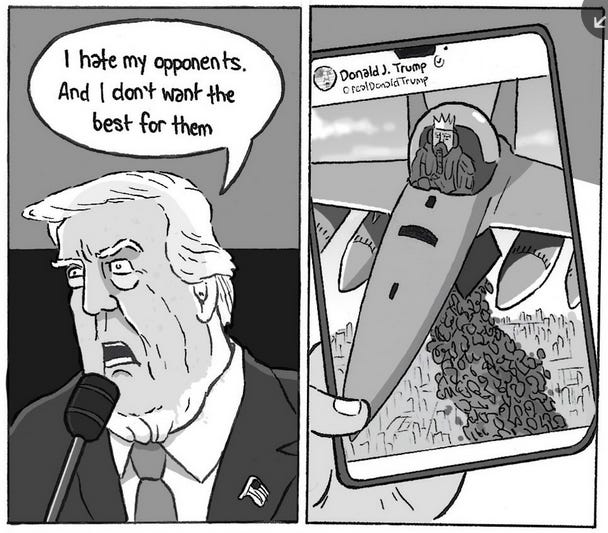
Warzel argues that Mamdani’s focus on creating videos with a clear creative treatment (as detailed in this interview with Mamdani’s team in Defector) stands in direct opposition to the current administration’s childlike delight in using clearly AI-generated videos.
There’s an authenticity at play here, alongside some classic campaigning principles of focusing in on the specific issues that New Yorkers felt were ignored by other politicians. The other factor Warzel pulls out is Mamdani’s commitment to his beliefs and his refusal to be cowed by anti-Muslim attacks. Instead of attempting to avoid those topics, the campaign doubled down on them - sharing “a video for Arabic-speaking voters in which Mamdani speaks the language fluently.”
Whatever the factors you want to highlight, there’s no doubt that Mamdani’s mayoral campaign deserves its place in the pantheon of “notable political campaigns advermarketingpr people draw lessons from” - alongside Vote Leave, Trump 2016 and Labour 2024.
And while Mamdani’s campaign may have little direct local relevance to anyone living outside of NYC, perhaps the reason it has inspired numerous think pieces in London agency land is that it feels fresh and new. And it feels like the political campaigning landscape could do with some of that freshness in 2025.
The Labour 2024 election playbook already feels decidedly out of step with the increasingly bleak news landscape. Instead, it’s the right wing of UK politics that appears to be setting the agenda. A case in point is Robert Jenrick, whose leadership campaign, which has been hiding in plain sight, has become increasingly prominent as the year has progressed.
Jenrick’s first notable social moment came in May, when a low-budget video of him confronting fare dodgers at Stratford Station achieved significant virality, leading to blanket media coverage and prompting Sadiq Khan to respond to the issue. A substantial win in anyone’s campaigning playbook.
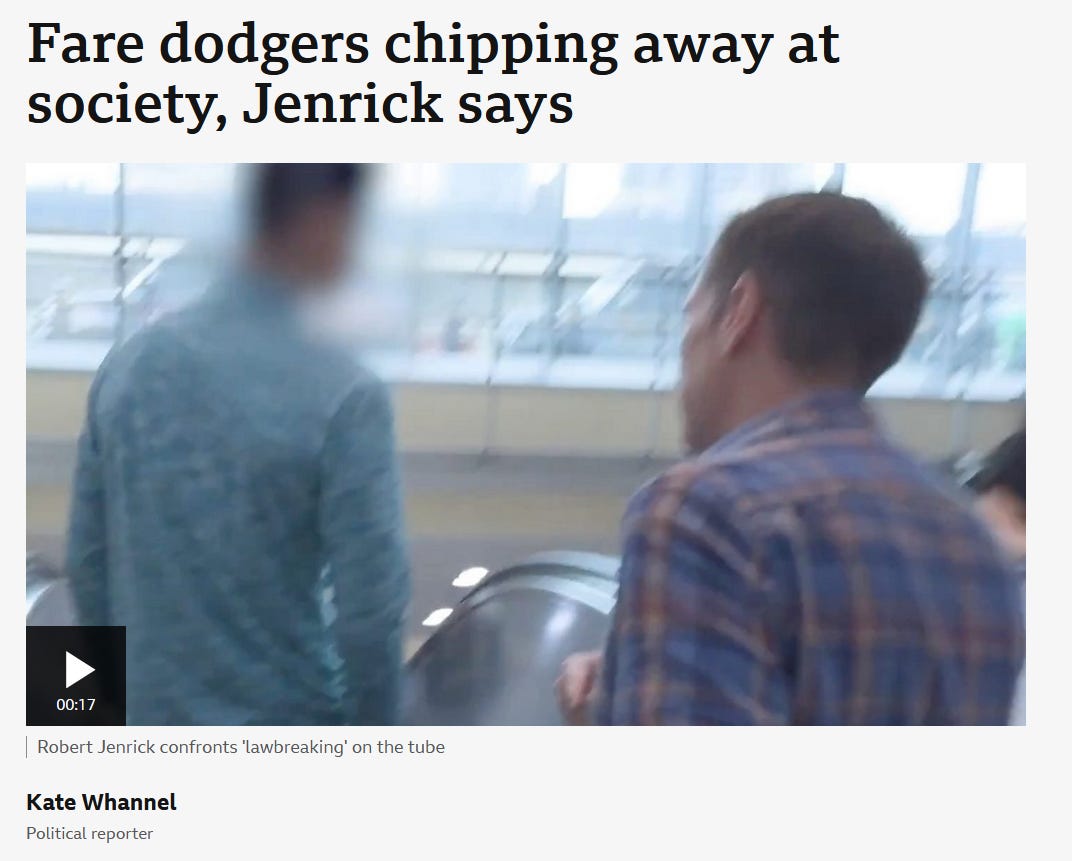
It’s the kind of viral victory that would embolden any creator, let alone a politician desperate for an increased share of the limelight. Jenrick clearly isn’t someone who would rest on his laurels, so I was interested to see how much of his social media activity attempted to replicate the success of the “Tube Dodger” video.
To do this, I scraped his Instagram and X posts over the past year, and uploaded them to a generative AI platform to analyse the most prominent themes and topics across the two platforms.
(It’s important to state at this point that genAI sometimes struggles with this kind of data coding task, particularly at large volumes. I used Apify to extract the social posts and found that uploading the data as a JSON file, rather than Excel, produced more robust results. However, that comes with the downside of not being able to adjust the data before it’s uploaded).
Anyway, here’s a visual breakdown of Robert Jenrick’s posts across two prominent platforms:
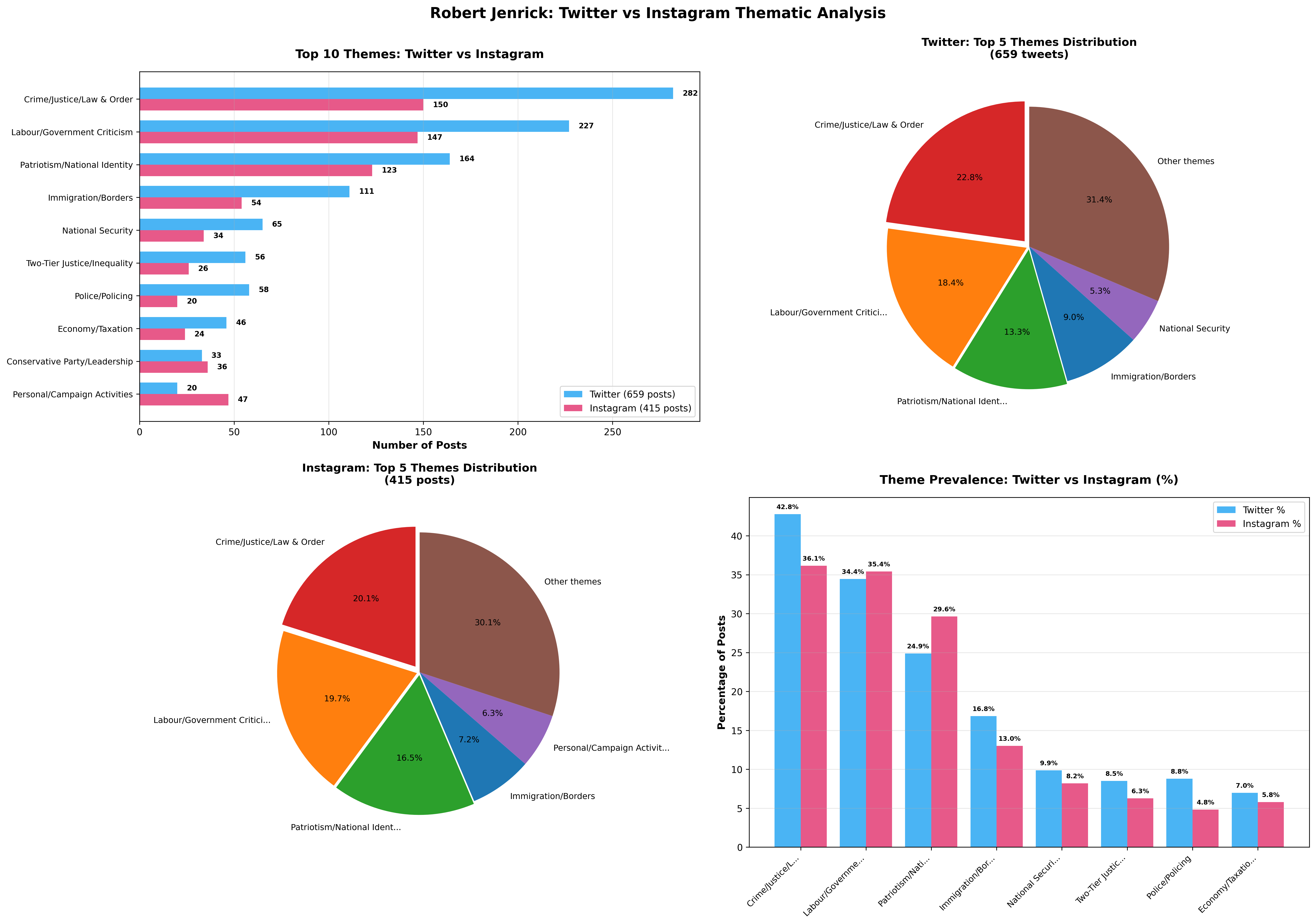
You can see a remarkable amount of consistency across the two platforms (alongside the classic genAI “other” bucket). The most significant difference is that, like any senior figure using social, Jenrick tends to keep personal activity reserved for his Instagram. You can also see a much higher overall volume of X posts, which again tallies with broader platform behaviour.
We can also see that thematically Jenrick takes his role as Shadow Home Secretary seriously, dominating his posts with a focus on law & order. Having scanned through the posts, I think we can also include a significant portion of his Labour attack posts under this banner, given his recent focus on David Lammy’s perceived failures around prisoners being mistakenly released.
The “share a video and generate coverage” approach worked a second time around too, with Jenrick’s most engaged Instagram video - a Sadiq Khan attack that used footage of shoplifters loading up a bag while a security guard looks on without intervening - also securing him coverage in The Sun and Daily Mail.
It’s the kind of thematic consistency any content strategist would be proud of. However, we know that social media is only ever one part of the story, whether that’s for politicians or broader comms and campaigning. What of Robert Jenrick’s broader media profile?
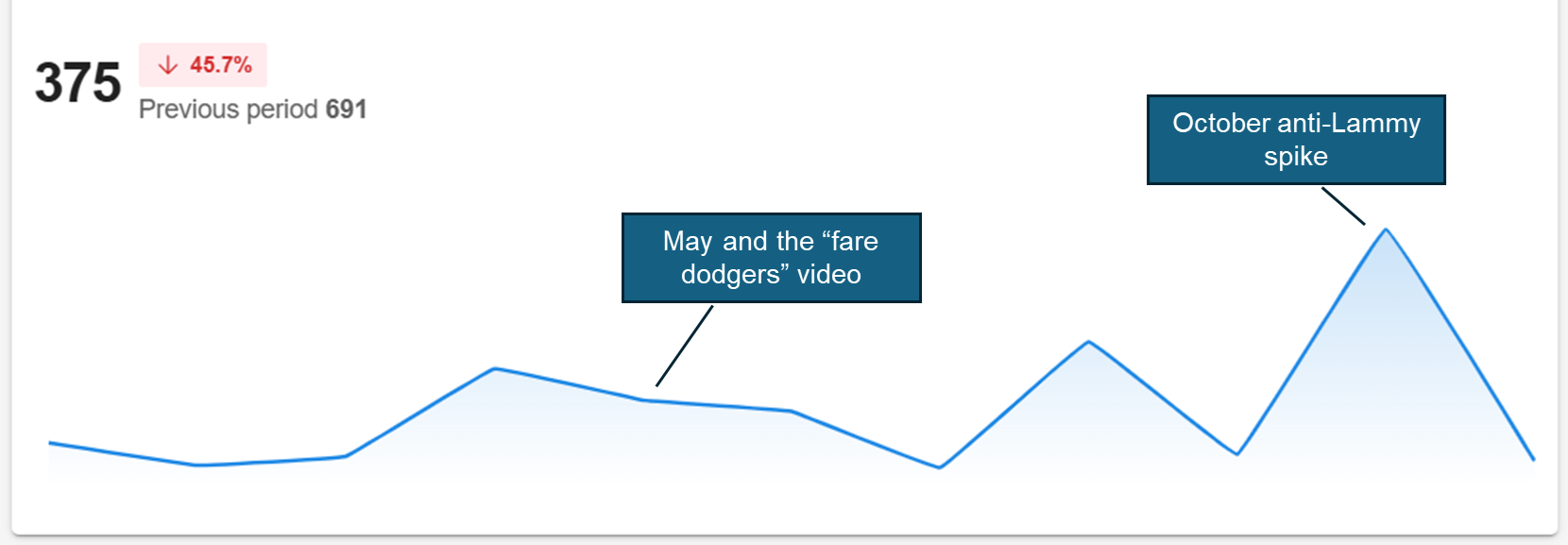
A Meltwater search for coverage where Jenrick was featured in the title of tier-one outlets (excluding the Daily Express) reveals that while the fare dodger campaign was undoubtedly successful, it didn’t generate a distinct peak of coverage. And his most significant media spike of the year so far is much more recent - those escaped prisoners, alongside some ill-advised swearing in front of Celebrity Traitor Kate Garraway, have secured a much larger boost in visibility.
Indeed, Robert Jenrick has discovered that the kind of virality generated by his fare dodger video is not always a simple rinse-and-repeat recipe. A more recent attempt at securing coverage - a survey story highlighting that young people don’t know much about the Battle of Britain - secured much more limited pickup than his posts squarely rooted in this law and order core thematic.
Clearly, political campaigning can learn as much from PR as the other way round. And a comms person would have spotted that the Battle of Britain research would struggle to generate much coverage on its own.
But for now, the flow of inspiration remains pretty one-way. PR and comms often look to political campaigns for inspiration - and I would argue that just because slopulism or poli-slop (does that even work?) doesn’t necessarily align with your personal tastes, it shouldn’t mean we ignore it in favour of maxing out on Mamdani. There’s plenty to take from slop and anti-slop, right and left alike.
My main thought from some, admittedly surface-level, reading on the Mamdani campaign is how he channelled a genuine connection with his audience. Clearly, this is easier on a smaller-scale mayoral campaign, but New York is pretty big and pretty diverse. The sense I get was that he understood which voters he needed to reach, and did so in a way that genuinely resonated. Audience understanding remains an underrated yet foundational element of any campaign or communications activity.
The sloppier end of the spectrum has made a virtue in playing to the crowd. They know what notes to hit, and they nail them every time. That’s why AI slop works so well for this side of the political spectrum - the focus isn’t on truth or accuracy. It’s about providing fodder that reinforces prejudice and preconception. I can’t remember where I read it, but someone spoke to social media users who had shared fake AI videos to see why they did it and if they realised they were fake. Most users were aware that the clips were AI-generated, but they didn’t care because they supported their point of view.
In comms, we often take on the election-coded challenge of winning over swing voters when working on campaigns aimed at changing hearts and minds. Those people who are most likely to be influenced.
But what if the new algorithmic video age has made swing voters irrelevant? What if the real job these days is to focus solely and squarely on your core, activating them to such an extent that they become inescapable, and end up providing that influence in and of themselves?
Perhaps all this approach needs is a catchy name to codify its popularity. Slopcore anyone?