Memorability and familiarity
How do we get the right balance of freshness and familiarity when coming up with memorable insights and ideas?

I feel like I’d forgotten what it was like to enjoy a sunny day. I know it’s terribly British to open a conversation with you, my reader, by talking about the weather. But I often just can’t help it - particularly as we emerge from a particularly damp and dreary winter.
But maybe I’ve forgotten not because of meteorological conditions, but as a natural consequence of ageing.
In his excellent Dissect season on Frank Ocean’s seminal “Blonde” album, presenter Cole Kuchna talks about how the album evokes memories of long, hot teenage summers.
Cole suggests these summers are so memorable because of the new experiences we write onto our mental hard drives. As we get older, the day-to-day becomes more dominated by routine and habits. Our years bleed into each other, with only the big moments sticking out.
From a work perspective, it’s often the pitches and the big campaign moments that stick in the memory. Their stickiness comes from the sheer effort they require, dominating your mental capacity for however long they last.
But we’re also desperately striving to make our pitches and big campaigns memorable and sticky for our audiences. We don’t want to be “just another corporate comms agency” that shows up with an opening slide titled “Your brief to us”.
And that’s a challenge, because in a pitch situation, you’re telling a story - and you want your story to feel compelling and build intrigue. Jumping straight into the big idea is a huge risk (ask me sometime about the pitch that I did backwards to Thorpe Park).
So we strive, both in pitch situations and in our industry more broadly, to find something new and exciting to put into the mix. We conduct our own primary research to have something fresh to present. We make extensive reference to generative AI, given our current cultural milieu. If I’m in the room, I’m probably going to tell you that your CEO uses too many reposts on LinkedIn, and reposts statistically underwhelm when it comes to engagement.
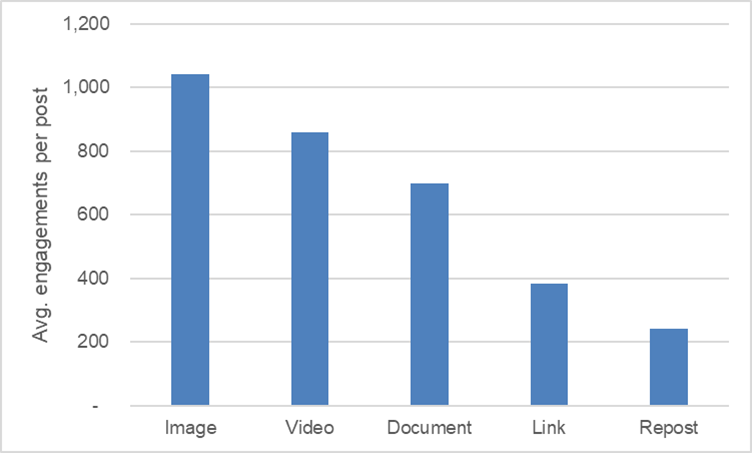
New doesn’t always have to be brand new, of course. A great insight (yes, I’m going there, you can @ me if you really want) finds a fresh way to look at the tried and tested. Comedians are the masters of this, identifying the “hidden obvious” in run-of-the-mill situations.
I know Rob Mayhew isn’t to everyone’s taste, but I find his videos effective because they’re so relatable. He continues to find gold within the agency grind.
But what if the hidden obvious isn’t actually that well hidden? There was a headline in my Campaign daily bulletin this morning that asks, “Are paid ads or organic posts the future of social?” It’s a tried and tested debate - the summer equivalent of another day commuting into the office and hoping to have some time in the sun.
It’s also a debate that only really matters to us in comms and ad land. Audiences don’t care - and in many cases, they can’t even tell the difference between sponsored and organic content. Based on Ofcom’s Adults’ media use and attitudes report, only 52% of UK adults can correctly identify the sponsored links on Google. It was also the younger end of the spectrum that was more likely to be incorrect - perhaps because they’ve all moved to TikTok for search.
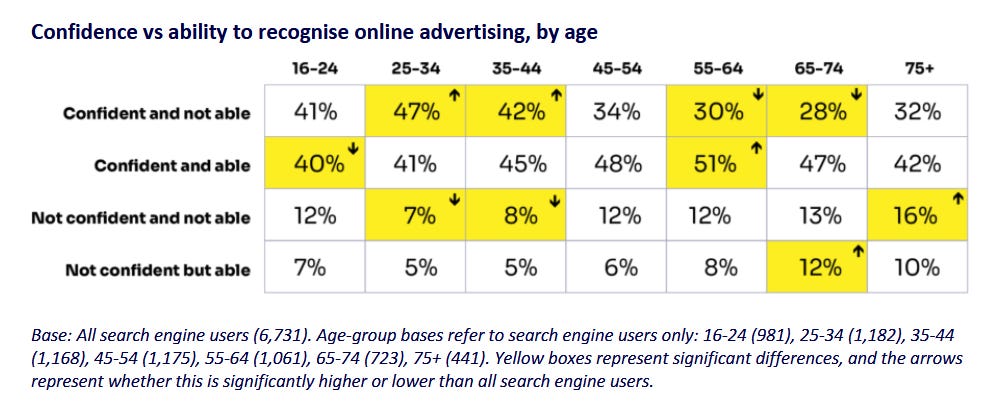
These are just a few of the data points within Ofcom’s latest media attitudes study. Ofcom’s reports are a regular goldmine of data and potential insight. But we often overlook these reports because they don’t feel fresh or new. Everyone has access to Ofcom; we’re different, we go deeper.
But if we truly believe in being audience-first or audience-led in our thinking, we need to move away from being too close to the micro debates of our industry and get closer to how different audiences spend their time consuming and searching for information. And there are many worse places you can start that journey than by looking through Ofcom’s data and reports.
The latest edition of the Adults’ media use and attitudes research comes loaded with potential jumping-off points to explore further and in a more specific fashion.
For example, “awareness that online content is tailored” fell to 76% this year, down from 85% last year. On closer inspection, we can see that a large part of this surprising lack of awareness stems from those aged 75+. 46% of this 75+ cohort were unaware of algorithmic timelines, compared with one in five among other age groups (which instinctively feels more accurate). It feels like there’s potential for exploration of the truisms we all accept (e.g., everyone knows about the algorithm) that can be unpacked in more detail.
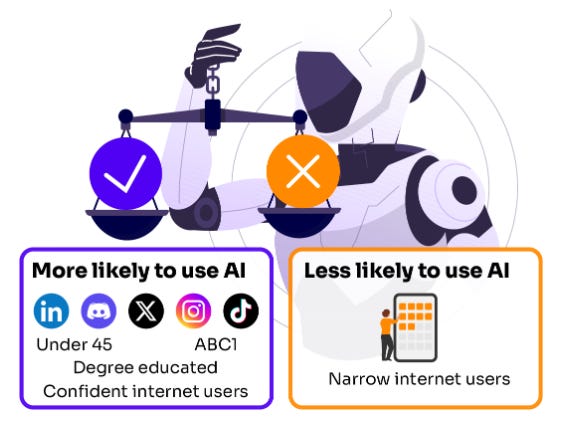
Or another combination of data points concerns the use of AI (bleeding into the hottest of hot topics, GEO). Ofcom found that genAI usage was highest among people who already use a range of different platforms. They also tend to be “professional”-type audiences: ABC1, degree-educated and under 45. There’s an emerging gap between those experimenting with and harnessing AI, and those who aren’t. Again, that feels like instinctively rich territory to explore - or at least a proof point to back up the importance of GEO and understanding how the different engines talk about your business and industry.
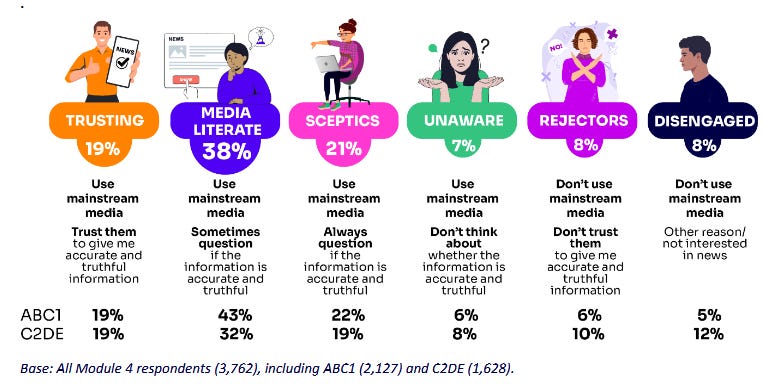
We also continue to see declines in trust of mainstream media, alongside outright rejection of both mainstream media and news in general. Nothing surprising or particularly interesting there. But perhaps we could combine this rejection of news with the fact that so many people get their news from social media (mainly Facebook), and with the types of stories mainstream outlets feel they have to post on Facebook to get algorithmic cut-through. My alt Facebook account follows a range of publishers, and the stories are almost overwhelmingly clickbait dross. If that were my media diet, I would turn off too.
There’s certainly rich territory to explore here further, particularly as we think about our channel mix in the age of GEO. I recently completed a YouTube audit for a client, which included an analysis of the comparative performance of a range of publishers on the platform.

Nearly all the publishers I analysed utilised the same scattergun, high-volume publishing approach they use on other channels. That meant the likes of BBC News and The Times’ views were dwarfed by Wired, whose team clearly understand the importance of curation and developing more YouTube-native videos that can drive algorithmic discovery. More and more clients ask us about YouTube for corporate brand storytelling - the answer is always be more Wired and less BBC News.
It’s definitely the case that a slide including Ofcom Media use and attitudes research will never be your most memorable, the pitch equivalent of that one glorious hot summer you romanticise in your memory.
But developing those points and insights requires a careful balance between a big-picture perspective and zeroing in on the important details. You will have your own approach that works to generate successful results - I tend to treat my process like pulling a thread to see what happens.
Sometimes the thread comes out easily, and the thought goes nowhere.
Sometimes the thread feels like it keeps coming, unravelling to reveal additional areas to explore.
Following the threads can lead you to the more memorable information. That’s the information that’s going to go a long way to making your pitch presentation stand out in a sea of sameness. Or to help you generate more distinctive creative ideas and assets that will grab your audience’s attention.