Antagonistic amplification
The case for being more "Greggs vegan sausage roll" in how we approach aspects of comms and campaigning.

As this current spate of crisis and conflict rumbles on, a few clients and teams internally have asked us, “Can we monitor Truth Social?”
The fact that our current tech stack (Pulsar, Signal, Meltwater, All Ears) doesn’t cover President Trump’s preferred mode of communication says a lot about Truth Social’s overall level of influence in the corporate world.
Of course, the need for a platform like Truth Social is less acute now. The platform came into life following President Trump’s ban from Twitter after the January 6th insurrection.
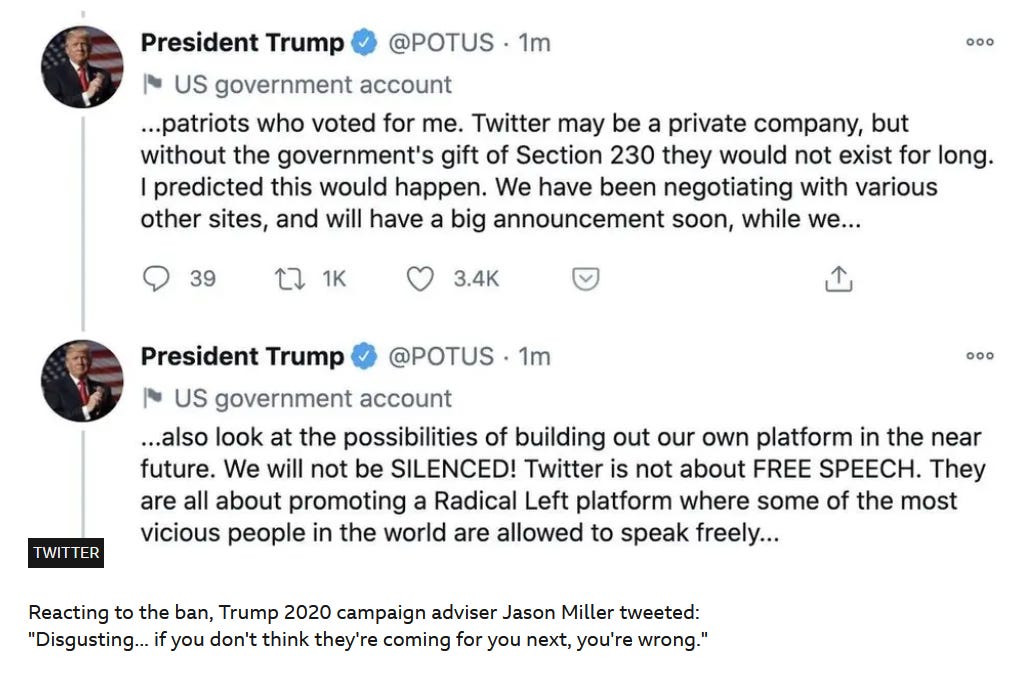
Now that Twitter has morphed into X and removed pretty much all its content moderation rules, you could argue Truth Social is kind of pointless.
But there’s also an argument that platforms like Truth Social with a heavy right-wing userbase inherently struggle because of self-selection. When everyone thinks the same, there’s no one there with ideologically opposing views to pick fights with.
Ryan Broderick has talked about this phenomenon in Garbage Day at length - that X continues to hold some sway precisely because there are enough users with polarised views on the platform to keep the conflict (and hence the dialogue) raging. Truth Social and Bluesky struggle to move beyond the fringes because they’re both essentially self-contained gardens.
I always thought this argument felt like an accurate insight, but I hadn’t seen any first-hand evidence to back it up.
And so it was that last week my colleague Tom Lawless asked if I could look into the online reaction to two opposing viewpoints on the net zero debate. On one side, you’ve got a concerted push by the IEA in January, that claimed the net zero transition would cost £4.5 trillion. On the other hand, we have more recent data from the Climate Change Committee showing that a net zero economy would reduce energy bills and save the country money in the long run.
The initial thesis was that the negativity would drive more coverage and social conversation - we know how successful climate change sceptics and deniers have been in disseminating their messages. Given our analysis mainly sourced data from X (with a bit of Bluesky and Reddit), the skew would surely be obvious.
Our data proved the initial thesis wrong - the January articles generated only 560 posts in total. By contrast, the reaction to the Climate Change Committee’s recent news generated 4,874 responses (focused purely on replies in both cases).
This volume disparity did not represent a sudden change of the political winds on X, or even a cabal of X users dedicated to solving the climate crisis.
The majority of the reactions were replies to prominent politicians sharing the positive CCC story, mainly Ed Miliband. My AI-led analysis of the tweet replies to Ed says they are “consistently abusive, with frequent profanity and ad hominem attacks”. I’m sure you can imagine the content - but I’m sure Ed has seen worse. He’s tuss enough to deal with it.
Replies to CCC coverage were also rooted in the disparity between the promise of cheaper bills and the lived experience of suffering through an era of unusually expensive energy (which is likely to get worse). North Sea drilling advocacy was also prominent in the mix, a Reform-led party line around UK self-sufficiency.
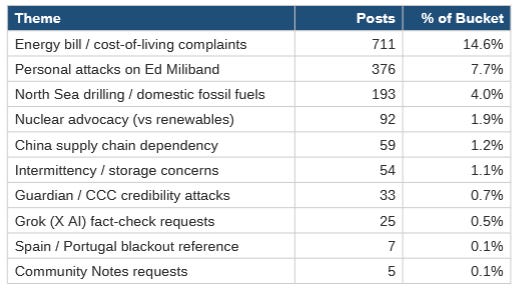
But whatever the content and tone of the replies, Ryan’s central thesis on the dynamics of conversation on platforms like X still holds. The viewpoint that backed up much of the online right’s feeling - i.e. that net zero is an expensive, lefty-led waste of time - didn’t spark much conversation. Pro-net-zero views, on the other hand, got people going.
It’s all about the fight, the challenge, the chance to dunk on someone and provide an outlet for the rage so many people seem to build up by spending time online (and particularly on X). X is no longer about community or networks of influence - it’s about shouting down your opponents as loudly as possible. That this is the approach is backed up by our finding that 8.3% of the anti-net zero posts we identifed used “auto-generated X handles” (i.e. @brendaj98869280, @jamessm79356044, @roberts89565048). These usernames tend to be associated with sock puppet accounts used for a specific purpose - indicating such accounts prefer to antagonise than to amplify.
All this data leads to a similar question to one I posed a few weeks ago - what would happen if we starved this particular bin fire of its oxygen? What if Ed Miliband, Caroline Lucas, Zack Polanski and every other left-leaning prominent politician and public figure quit posting on X? Who is left to argue with? Where would the rage go?
(Ed, if you’re reading this, I’d be happy to help you get off X and onto LinkedIn).
Most likely, as Ryan’s team at Garbage Day, X would lean even more heavily into its role as a cross-platform rage amplifier. The most common pathway is for some user on X to share a TikTok they’ve seen, which users dunk on and build a narrative around until it generates a reaction. The narrative generates either an argument (great) or media coverage (even better).
The platform dynamics are too ingrained - the users who have stuck with X throughout all the madness and chaos won’t be leaving any time soon. And while they find conflict easy to come by, they’ll make hay. And if the conflict takes longer to identify or manufacture, then so be it.
The question is, what to do with our findings around X’s anatagonistic, counterintuitve trends around amplification.
The easiest answer is to follow the path most businesses have chosen - stop proactively posting on X, but keep your profile live in case of inbound comments or to use the account for monitoring.
But perhaps there’s a bolder play, which leans into the Greggs’ “vegan sausage roll” playbook - design campaigns to deliberately provoke opprobrium on X. If we know users and bots on the platform are desperate for conflict, we could give it to them - and then see how the noise converts into greater awareness of our issue (either directly or via media coverage).
It’s clearly a high-risk ploy that has the potential to backfire spectacularly. But for the right brand or business, with confidence in its position and its positioning, deliberately kicking the hornet’s nest could easily turn another run-of-the-mill report into something more talkable. The Climate Change Committee’s news wasn’t exactly fire, but the petrol X poured on it certainly ignited it into something more substantial.
So perhaps there’s an argument for campaigns being a bit more Prodigy in their approach in the 2020s - starting some fires and seeing what might happen. Sure, like Keith Flint appearing on Top of the Pops in 1996, you might get some complaints coming your way - but you might also end up with the comms equivalent of a number one single. High-risk also means high-reward. And whether we like it or not, X still carries a degree of clout - at least a lot more than Truth Social does as a platform.